
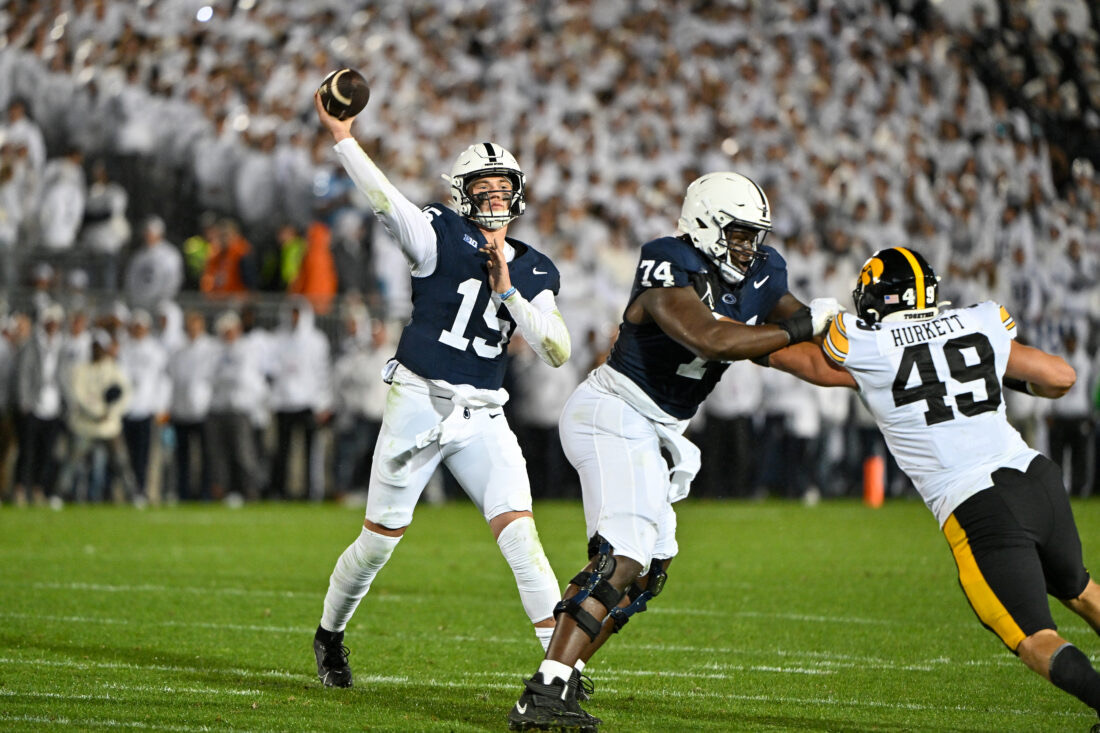
The ever evolving quarterback position – the most important position on the field, the position that dictates the pacing and results of a game, and the hardest one to get right as an evaluator. A quarterback can make or break your playoff chances, let alone a run for the Super Bowl. They are the critical factor on a football team, oftentimes the catalyst that puts the team over the top to win the big game.
Traditionally, quarterbacks have had to be proficient processors and passers to keep their teams competitive. However, we have seen the rise in recent years of athletic quarterbacks who use their running ability to keep their teams involved in games and make up for any deficiencies they have as passers. Many times, offensive coordinators have found ways in that span to make throwing the ball easier for them, simplifying read progressions and creating key defenders within the game plan.
Regardless, to win at the highest levels a quarterback has to be a high-level passer. Even the athletic quarterbacks haven’t been able to completely topple the mantra, falling short in the end to stingy defenses who force them to win from the pocket. The athletic quarterbacks who have won the big games have not been very limited in the passing game.
The natural responsibilities of the position demand that quarterbacks be the leaders, given that the offense runs through them in some way on every play. That leadership can make or break a locker room and is a critical factor of an evaluation.
Get the Complete 2026 NFL Draft Guide Here!
How to Scout Quarterbacks: Evaluation Breakdown
| Arm Talent | |
| Arm Strength | Assess the prospect for arm talent – how far can he throw the football and what is his effective range? Does he spin the ball with good velocity and command? |
| Touch Ability | Now take that back a step – can the prospect control the velocity in which he’s throwing the football? |
| Release | How quickly can the prospect get the football out? This includes his step into the throw and follow through with his arm. Does he utilize different arm slots? |
| Accuracy/Placement | |
| Accuracy | How generally accurate is the quarterback? How often does he get the ball to the receivers? Is he often erratic with where the football goes, does he have command of the throw? |
| Placement/Vision | Placement is more about the finer details. Can he throw with anticipation and put the ball in the right spot? Is he a box-placement (get the ball to the general vicinity) or pinpoint thrower? |
| Pocket Presence | |
| Pocket Poise | How comfortable is he working in the pocket? Does he often abandon the pocket, and why does he do it? How poised is he when the pocket condenses? |
| Pocket Maneuverability | How well does the prospect maneuver the pocket? Can he step up without looking at the rush, having a natural feel for pressure? Does he move to the right spots or move into sacks? |
| Footwork | |
| Drop Consistency | How consistent is his drop and platform? Is it three steps back on a three step drop or is his drop muddled? When he gets to the top of his drop, does he explode off of it and step up or settle? |
| Quickness | How quick does he move his feet through his drop? Is he getting through his drops quickly? How light are his feet in general? |
| Mobility | |
| Outside Pocket | How well does the prospect move outside of the pocket? Does he out run defenders? How comfortably does he throw while he is on the move? |
| Downfield Ability | What kind of an athlete is the prospect? Is he a runner or a scrambler? How effective is he in either role? Is he a physical runner or does he take care of himself? |
| Improvability | |
| Natural Improvability | How well does the prospect react when the play concept breaks down? Can he create as a passer, as a runner, or as both? How creative is he? |
| Play Extension | How well can he move to keep the play concept alive? Can he extend plays with his movement ability? |
| Football IQ | |
| Pre-Snap | How well does the prospect read the field pre snap? Does he do checks, or does he check with the sideline? Does he pick up on blitz looks? |
| Adjusting Post Snap | How well does he read his concept against defenders? Does he have a key defender most times or can he read the field? |
| Protections | What kind of an understanding of protections does he show? Is he making the checks or is the center/sideline doing it for him? |
Measurements and Testing Data
Quarterbacks come in all shapes and sizes, with different builds and athletic profiles from ultra-athletic to very unathletic (by NFL standards). Most of the evaluation is done in the film room and in interviews, as quarterback is the position that fringes on this more than any other position.
That being said, the one measurement that teams take seriously are hand measurements. 900 hands seem to be the cut off except in extreme situations, and they preferably want them bigger. Hand size comes into play because of the grip on the football, but it isn’t a sure-fire indicator for success. Joe Burrow has 900 hands. Michael Penix’s hands are 1048.
Position Specifics
| Category | Mean | Min | Max |
| Height | 6026 | 5101 | 6063 |
| Weight | 221 | 192 | 244 |
| WING | 7600 | 6948 | 8318 |
| ARM | 3178 | 2848 | 3428 |
| HAND | 948 | 858 | 1058 |
| 10-Split | 1.70 | 1.52 | 1.81 |
| 40-Dash | 4.82 | 4.40 | 5.27 |
| Vert | 31.5 | 26.0 | 40.5 |
| Broad | 9-3 | 8-0 | 10-9 |
How to Scout Quarterbacks: Player Attributes
These are the terms used in the Draft Guide to describe the attributes of players.
Athletic – Features good athletic traits, mostly in a scrambling ability. Stands out among his peers in this way.
Raw – A very raw prospect with a lot of developing to do. Usually doesn’t have a good platform or fundamentals for the position.
Strong-Armed – A strong-armed quarterback who leans on his arm as his trademark trait. Fires deep with velocity.
Toolsy – Usually a combination of athleticism and arm talent, just has the good stuff for the position.
Player Types
These are the terms used in the Draft Guide to describe the types of players.
Athlete – Relies on his athleticism to play the quarterback position, best served as a runner.
Game Manager – A quarterback who can manage a game and play within structure, and doesn’t do too much outside of that.
Gunslinger – Fearless competitor who isn’t afraid to put the ball into dangerous spots and just spin it downfield with confidence.
Improviser – A quarterback who does his best work outside of the pocket and creating when the play breaks down.
Top 10 NFL Quarterbacks
| Team | Player | Grade |
| KC | Patrick Mahomes | 10.0 |
| BUF | Josh Allen | 9.8 |
| BAL | Lamar Jackson | 9.7 |
| CIN | Joe Burrow | 9.5 |
| LAC | Justin Herbert | 9.0 |
| DET | Jared Goff | 8.5 |
| DAL | Dak Prescott | 8.1 |
| HOU | CJ Stroud | 8.0 |
| PHI | Jalen Hurts | 8.0 |
| WAS | Jayden Daniels | 8.0 |
What makes Patrick Mahomes the best?
Patrick Mahomes is the perfect blend of game manager, improviser, and gunslinger with good athletic traits and ability to compliment his skillset.

| #15 | Patrick Mahomes | 10.0 | Athletic Improviser |
| HT | 6021 | WING | 7848 |
| WT | 225 | ARM | 3328 |
| 10-Split | 1.65 | HAND | 928 |
| 40-Dash | 4.80 | Vert | 30.0 |
| Broad | 9-5 |
Coming in with his measurables right around average, Mahomes has a highly developed skillset to compliment his tools and fundamentals, in addition to capable athletic ability.
He wins with his accurate passing. He can dice you up as a game manager, then throw it over the top of you, and when you take his throwing options away, he’s a crafty scrambler. There’s not a good way to defend him other than to outscore him.
Make sure you check out the Guide for all of the top quarterbacks prospect reports in college football!
Leave a Reply